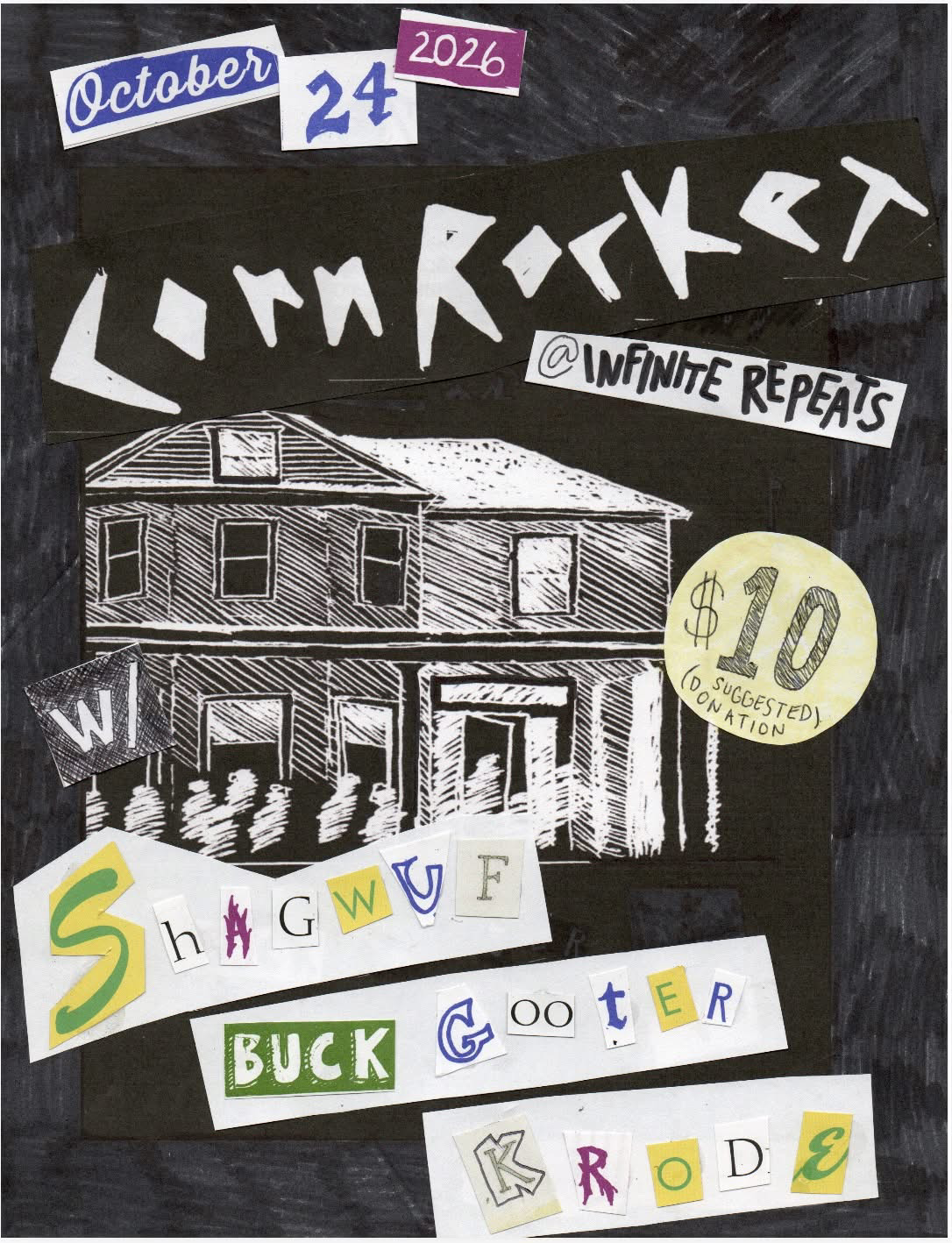
DIY October: Pt. 2 No More Punk Time.
Kyle Johnson, Pat Jarrett and Tarik Begik — creators of No More Punk Time, the Last Days of Crayola House.
What makes a house full of loud music, sweaty bodies, and a bunch of people who just want to belong so fucking special?
Turns out, a lot.
For more than three decades, a house in Harrisonburg, Virginia, became something much bigger than a place for bands to play. It became a community, a home for the DIY music scene, an icon of punk culture and a place where generations of musicians and music lovers found their people.
Now there's a film about it.
A couple of months ago, I had the opportunity to attend a private screening of the documentary No More Punk Time: The Last Days of Crayola House, and I jumped at the chance. After seeing the film and talking with the team behind it (director Tarik Begic and producers Pat Jarrett and Kyle Johnson) I knew I had to write about it. Because this story matters.
The film documents 32 years of Crayola House history, ending with its closure in 2024. Tarik Bejik, Kyle Johnson and Pat Jarrett spent two years working on the documentary, sorting through hundreds of hours of archival footage and conducting more than 60 interviews.
It’s impossible to talk about the film without talking about the ethos of punk. As a musical genre it’s only one expression of a much broader cultural movement. From New York's mid-1970s scene to British punk and later American hardcore, each had its own sound, identity, and sometimes very different set of political beliefs. What connected the dots was a rejection of the idea that you needed permission, technical mastery, commercial approval, or institutional support to create something meaningful.
Anyone can do it. That's punk. And it’s what punk's DIY culture is all about. It's taking ownership of how music, art, and culture are created and shared.
This is exactly how the Crayola House story began.
In the early 1990s, the basement of a house in Harrisonburg rented by a bunch of JMU students and friends became a place for bands to play. Starting out as the Corn Rocket house, it became somewhere for people to gather. That gathering became a scene, eventually known as Crayola House. Over the years, Crayola House became part of Harrisonburg's cultural history.
A basement became a venue. A venue became a community. And that community lasted for decades.
Crayola House is a remarkable example of a DIY institution that lasted far longer than many other spaces trying to do something similar. Harrisonburg's house-show culture existed as a broader network, not just Crayola House alone. But while some spaces lasted a semester or even a single show, Crayola House survived for decades. It was special. For a reason.
It offered people a place to belong without necessarily fitting into mainstream social groups. It provided opportunities for young musicians to perform, sometimes for the very first time. It offered musicians and audiences exposure to different musical genres, artistic expressions, and people from different walks of life. Again, it wasn't just punk rock. It was everything.
It also gave people an opportunity to contribute to the scene and become part of it, rather than simply being fans or consumers of the music. These weren't just shows. They were shared experiences that became lifelong friendships and memories. That’s what makes a place like Crayola House more than just a venue.
These three artists, Begik, Johnson and Jarrett, decided this was a story that needed to be told. They organized its production, raised money, and made the film independently, outside the conventional studio system.
On their own. DIY.
There's something particularly meaningful about a DIY film documenting the history of a DIY music community. Within DIY culture, who preserves the history of communities that were never built to be permanent in the first place?
By collecting these stories, Tarik, Pat and Kyle are doing something similar to the people who created independent music publications decades earlier. They're preserving a culture and a place through this film.
Old posters get tossed in the trash. Photographs sit in shoeboxes or on old phones. Videos get lost. Memories fade. No More Punk Time brings those memories back together and celebrates them. Perhaps that's one of the most important things about the film. Crayola House may be gone, but the community it created, the music that came through its basement, and the people whose lives it touched are still here.
Places like Crayola House mattered in the past and still matter today because we need them. The kids need them. The musicians need them. In a world where divisiveness has become the norm, we need places like this more than ever. Places to connect, to feel welcome, to be accepted, and to scream and jump around and let it all out.
No More Punk Time captures more than 30 years of a house that exemplified the Punk ideal, preserving the people, the music, the memories, and the community that made it special.
Perhaps even more importantly and the very reason CSC is pushing this October DIY series, NMPT will inspire the next generation of kids in our scene to take the leap, to start a band, to get a house, to print flyers, to host shows, to make art, to become legends.
To keep the dream alive and to pass it on.
World Premiere - Virginia Film Festival
No More Punk Time: The Last Days of Crayola House
Thursday, October 22, 2026
8:15 PM
Violet Crown 5 - Charlottesville, Virginia
105 minutes, followed by a discussion with director Tarik Begic and producers Pat Jarrett and Kyle Johnson.
Film Screening & Live Music - Infinite Repeats
Corn Rocket with Shagwuf, Krode & Buck Gooter
Saturday, October 24, 2026
Infinite Repeats - Charlottesville, Virginia
6:00 PM - Screening of No More Punk Time: The Last Days of Crayola House
8:00 PM - Live music